Recursion
CSC 385 - Data Structures and Algorithms
Brian-Thomas Rogers
University of Illinois Springfield
College of Health, Science, and Technology
What is Recursion?
What is Recursion?
- We often solve a problem by breaking it into smaller problems
- Keep breaking into smaller problems until a problem with a known solution is reached
- This is the base case
- Example: Counting down from 10
Counting down from 10
Recursion with Explicit Base Case
public static void countDown(int integer) {
    //Explicit Base Case
    if(integer == 1) {
        System.out.println(integer);
    } else {
        System.out.println(integer);
        countDown(integer - 1)
    }
}
We state what the stop condition is. Recursion stops when condition is true. integer == 1
Tracing the Recursive Method
- One method is by Stack Trace

Copyright ©2012 by Pearson Education, Inc. All rights reserved
Stack Tracing
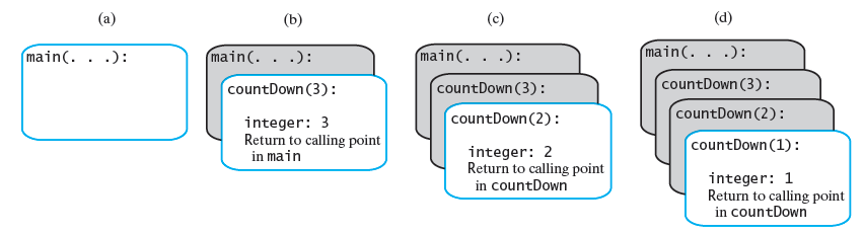
The stack of activation records during the execution of the call countDown(3)
Stack Tracing
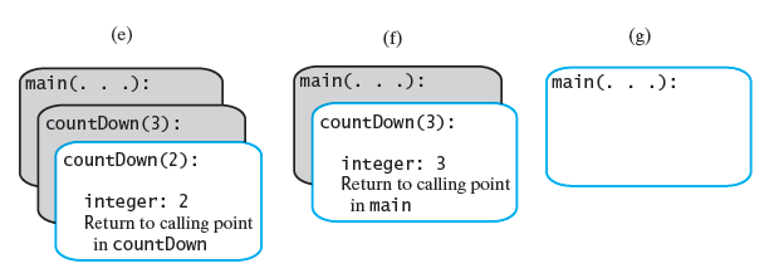
The stack of activation records during the execution of the call countDown(3)
Fundamentals of Recursion
Fundamentals
- There must be a base case. Base case can be solved without recursion and is the simplest form of the problem. It is also the termination point where recursion stops.
- Every recursive call must progress towards the base case. Otherwise, the base case will never be reached and the recursion will never terminate.
- Always assume the recursive call works.
- If you have multiple recursive calls in an algorithm, make sure they don’t solve the same instance of a problem more than once.
- Any problem that can be solved recursively can also be solved iteratively with extra work.
Question 1
What is wrong with the following recursive method?
Answer: There is no base case. The method will never terminate.
Question 2
What is wrong with the following recursive method?
public static void countUp(int integer) {
    if (integer > 0) {
        countUp(integer + 1);
    }
    System.out.println(integer);
}
Answer: The method does not progress twoards the base case for values greater than 0. The base case will never be reached.
Fixing CountUp
- How do you fix the countUp method from the previous slide?
Fixing CountUp
- How do you fix the countUp method from the previous slide?
public static void countUp(int integer) {
    if (integer > 0) {
        countUp(integer - 1);
    }
    System.out.println(integer);
}- In the call to countUp we should change the + to a -.
Recursive Methods that Return a Value
- Lets compute the sum \(1 + 2 + 3 + ... + (n - 1) + n\)
- For any integer \(n > 0\)
Tracing SumOf
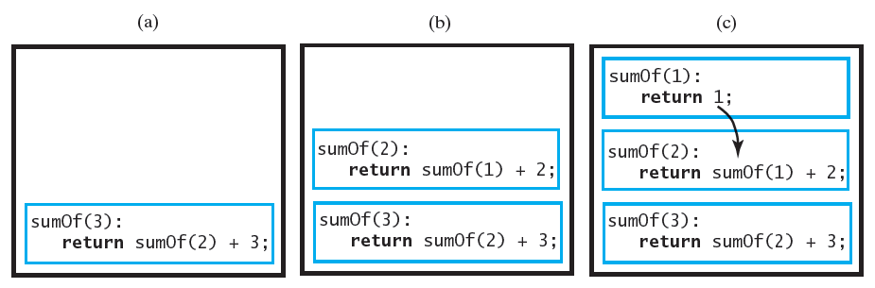
Tracing the execution of sumOf(3)
Tracing SumOf
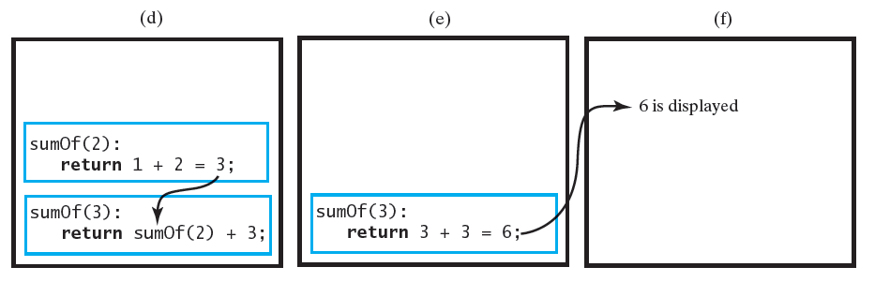
Tracing the execution of sumOf(3)
Question
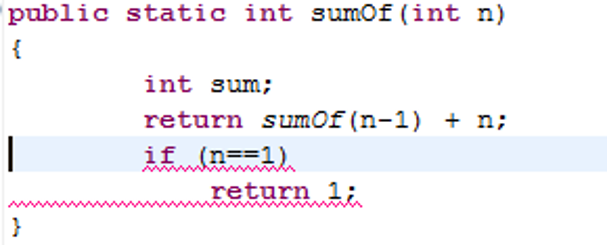
- What is wrong with the following sumOf method?

Towers of Hanoi
Simple Solution to Difficult Problem
- Recursion can sometimes be a great way to write a solution to a very complicated problem using a very small amount of code
- Consider the Towers of Hanoi puzzle
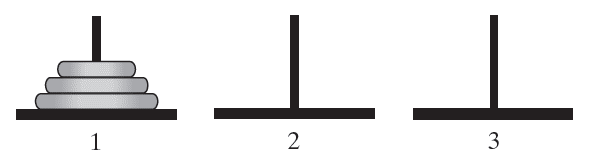
The initial configuration of the Towers of Hanoi for 3 disks
Towers of Hanoi Rules
- Move the disks from the first pole to the third pole
- Move one disk at a time
- Must only move topmost disk from any pole
- No disk may rest ontop of a disk smaller than itself
Solution of 3 Disks
- Smallest number of moves is 7
Recursive Solution
- The non-recursive solution to this problem is complicated
- However, the problem is very easily solved using recursion
- To solve for n disks
- Move the top n - 1 disks from first pole to second pole using the third pole temporarily
- The nth disk is moved to last pole
- Move the top n - 1 disks from the second pole to the third pole using the first pole temporarily
Recursive Solution Illustrated

The smaller problems in a recursive solution for four disks
Recursive Algorithm
Pseudocode
Algorithm solveTowers(numberOfDisks, startPole, tempPole, endPole) {
    if(numberOfDisks > 0) {
        solveTowers(numberOfDisks - 1, startPole, endPole, tempPole)
        Move disk from startPole to endPole
        solveTowers(numberOfDisks - 1, tempPole, startPole, endPole)
    }
}
Java Implementation
public static void solve(int disks, int start, int temp, int end) {
    if(disks > 0) {
        //move n - 1 from start to temp using end as auxiliary
        solve(disks - 1, start, end, temp);
        System.out.println("Move disk " + start + " to " + end);
        //move n - 1 from temp to end using start as auxiliary
        solve(disks - 1, temp, start, end);
    }
}
Problems with Recursion
- Biggest issue, not efficient with resources
- Each recursive call creates a new activation record with its own local variables
- Too many recursive calls can cause a StackOverflow error and crash the program
- Recursion can result in the same instance of a problem being solved more than once which can reduce performance.
Fibonacci Sequence
- Famous recursive sequence
- Defined as
\[ \begin{align*} F(0) &= 0 \\ F(1) &= 1 \\ F(n) &= F(n - 1) + F(n - 2) \end{align*} \]
- Sequence generated: 0, 1, 1, 2, 3, 5, …, etc.
Recursive Algorithm
Algorithm Fibonacci(n) {
    if n <= 1
        return n
    else
        return Fibonacci(n - 1) + Fibonacci(n - 2)
}- Note the two recursive calls
- Example call
- Fibonacci(10) => 55
Tracing Execution
- Do not do a stack trace when multiple recursive calls are guaranteed
- To trace, use a recursive tree
- First value will be initial value
- Draw branches for each recursive call
- In the case of Fibonacci, left branch will be the n - 1 call and right branch will be n - 2 call
- Do this for each new branch until you reach a base case
Recursive Tree
- Suppose the call is Fibonacci(5)
- The value 3 is calculated twice and the value 2 is calculated three times
Recursive Tree
- Try Fibonacii(6)!
- Can we do better?
Dynamic Programming
Dynamic Programming
- It is possible to improve the performance of the recursive Fibonacci while maintaining the elegance of the code
- The key is to keep track of values that have already been calculated
- This is called dynamic programming
- In dynamic programming the solution to each subproblem is only computed once and then stored in a collection and when the subproblem appears again later you just reuse the same solution.
Fibonacci Dynamic Solution
- First, let us determine how we want to store the solutions.
- Create a table!
| n | Fibonacii(n) |
|---|---|
| 0 | 0 |
| 1 | 1 |
| 2 | 1 |
| 3 | 2 |
| 4 | 3 |
| 5 | 5 |
| 6 | 8 |
| 7 | 13 |
- Notice
ncan be the values 0 to any positive integer - Looks like an array can be used to keep track of solutions!
- This is important because we want a collection that allows for quick retrieval and Arrays don’t get any better!
Fibonacci Dynamic Solution
- Lets keep track!
public static int fib(int n) {
    int known[] = new int[n + 1];
    for(int i = 0; i < known.length; i++) {
        known[i] = -1;
    }
    return fib(n, known);
}

private static int fib(int n, int known[]) {
    if(n <= 1) {
        return n;
    }

    if(known[n] != -1) {
        return known[n];
    }

    known[n] = fib(n - 1, known) + fib(n - 2, known);

    return known[n];
}
Notes
- Another method was introduced that takes the initial starting value but then calls the recursive method.
- This method is called a guarded method which prevents anyone outside the class from calling the recursive method and passing in bad arguments.
- The array was initialized with all -1 values
- This is because by default, the array will contain all 0’s but we need a value that indicates the result is not known
- 0 is a valid result in the sequence given in the previous slides
- So we use -1 instead
Notes continued
- There are now two base cases
- The first one determines if we have reached a value less than or equal to 1
- The second one determines if we already know the answer in which case just return the result
- In order for this to be efficient, fib(n - 1) must be done FIRST!
Recursive Tree
- Now the tree becomes the following
- Notice now, we no longer expand already known solutions!
Recursion vs. Iteration
Recursion vs. Iteration
- Any problem that can be solved recursively can be solved iteratively. But which is better?
- For most problems, an iterative solution is more efficient than a recursive solution
- This does not mean that recursion is bad practice!
- Recursion sometimes offers elegant solutions to an otherwise extremely difficult problem
- More importantly, many algorithms are given as recursive solutions
Time Efficiency of Recursive Algorithms
Time Efficiency of Recursive Algorithms
Below are the steps to take when analyzing the time requirement of a recursive algorithm
- Decide on parameter
nindicating the input size - Identify the basic operations
- Set up a recurrence relation
- Solve the recurrence and determine its order of magnitude
Time Efficiency of countDown method
- The input size is the size of the integer
n. - When
n = 1the statementSystem.out.println(n)is executed one time for \(O(1)\) - When
n > 1both theprintlnstatement and the recursive method call are executed.- But what is the order of magnitude for the recursive method?
Time Efficiency of countDown method
- Let us use \(T(n)\) to represent the time requirement
- We get the following relation
\[ \begin{align*} T(1) &= O(1) \\ T(n) &= T(n - 1) + O(1) \end{align*} \]
countDown Recurrence
- Expand the recurrence to see behavior
- We’ll use \(T(4)\)
Expand to base case \[ \begin{align*} T(4) &= T(3) + O(1) \\ T(3) &= T(2) + O(1) \\ T(2) &= T(1) + O(1) \\ T(1) &= O(1) \end{align*} \]
Go back up substituting previous T(n) solution to right hand side \[ \begin{align*} T(1) &= O(1) \\ T(2) &= O(1) + O(1) = O(2) \\ T(3) &= O(2) + O(1) = O(3) \\ T(4) &= O(3) + O(1) = O(4) \end{align*} \]
countDown Recurrence continued
- If we expand for \(T(n)\) we get
\[ \begin{align*} T(n) &= T(n - 1) + O(1) \\ &= T(n - 2) + O(1) + O(1) \\ &= T(n - 3) + O(1) + O(1) + O(1) \\ \dots \\ &= ((n - 1) O(1)) + T(1) \\ &= O(n - 1) + O(1) \\ &= O(n) \end{align*} \]
\(T(1)\) is the base case*
Confirm with Induction
- Guess is \(T(n) = O(n)\)
- Show base case is true
- \(T(1) = O(1)\) ✓
- Show inductive case is true
- \(T(n + 1) = O(n + 1)\)
\[ \begin{align*} T(n + 1) &= T(n) + O(1) \\ &= O(n) + O(1) \\ &= O(n + 1) ✓ \end{align*} \]
Time Requirement of Towers of Hanoi
- There were two recursive calls for Towers of Hanoi
- \(n\) will represent number of disks
- Each call reduced the problem by 1
- Recurrence Relation becomes
\[ \begin{align*} T(1) &= O(1) \\ T(n) &= T(n - 1) + T(n - 1) + O(1) \\ &= 2T(n - 1) + O(1) \end{align*} \]
Solving Towers of Hanoi Recurrence
Example of expansion
Reduce to base case
\[ \begin{align*} T(3) &= 2T(3 - 1) + O(1) = 2T(2) + O(1) \\ T(2) &= 2T(2 - 1) + O(1) = 2T(1) + O(1) \\ T(1) &= O(1) \end{align*} \]
- Build solution back up from base case
\[ \begin{align*} T(2) &= 2T(1) + O(1) = 2(O(1)) + O(1) = 3O(1) \\ T(3) &= 2T(2) + O(1) = 2(3O(1)) + O(1) = 7O(1) \end{align*} \]
Towers of Hanoi Recurrence
- Still not quite seeing a pattern
- Create a table!
| n | T(n) |
|---|---|
| 1 | O(1) |
| 2 | 3 O(1) |
| 3 | 7 O(1) |
| 4 | 15 O(1) |
| 5 | 31 O(1) |
- Those multiples are 1, 3, 7, 15, and 31
- This leads to O(\(2^n - 1\))
Towers of Hanoi Recurrence
- Let us use induction again to check our answer
- Our guess: \(T(n) = O(2^n - 1)\)
- Base case
- \(T(1) = O(2^n - 1) = O(2^1 - 1) = O(1)\) ✓
- Inductive case
- Need to show \(T(n + 1) = O(2^{n + 1} - 1)\)
\[ \begin{align*} T(n + 1) &= 2T((n + 1) - 1) + 1 \\ &= 2T(n) + 1 \\ &= 2(2^n - 1) + 1 \\ &= 2^{n + 1} - 2 + 1 \\ &= 2^{n + 1} - 1 ✓ \end{align*} \]
BigO Final Result
- Towers of Hanoi solution is \(O(2^n)\)
- That’s a slow algorithm!
BigO Based On Tree
- We can get the number of executions by drawing the recursive trees for n = 1, n = 2, n = 3, etc and counting the total number of values in the tree
- From that we can deduce the number of calls given n.
Recursive Trees for Towers of Hanoi
n = 1 disk
Only 1 call
n = 2 disks
3 calls
n = 3 disks
7 calls
Recursive Trees for Towers of Hanoi
- The trees show that the number of executions becomes
\[ \sum_{i=0}^n{2^i} \]
- Because the number of calls made is double the previous number of calls in the tree
- This is a well known summation which has \(2^n - 1\) as a closed equation which is what we got above
Fin!
To learn more about recursion, click here

CSC 385 - Data Structures and Algorithms